

拉斯维加斯赌城

图片

Bachelor / Master theses in Organic Semiconductors

Theses in Organic Semiconductors

Topics for theses are available on request, see below for a current overview of possible topics.

?

Please contact the theses supervisors given below or? Prof. Wolfgang Brütting

?

All theses can be written in German or English.

Overview on Topics

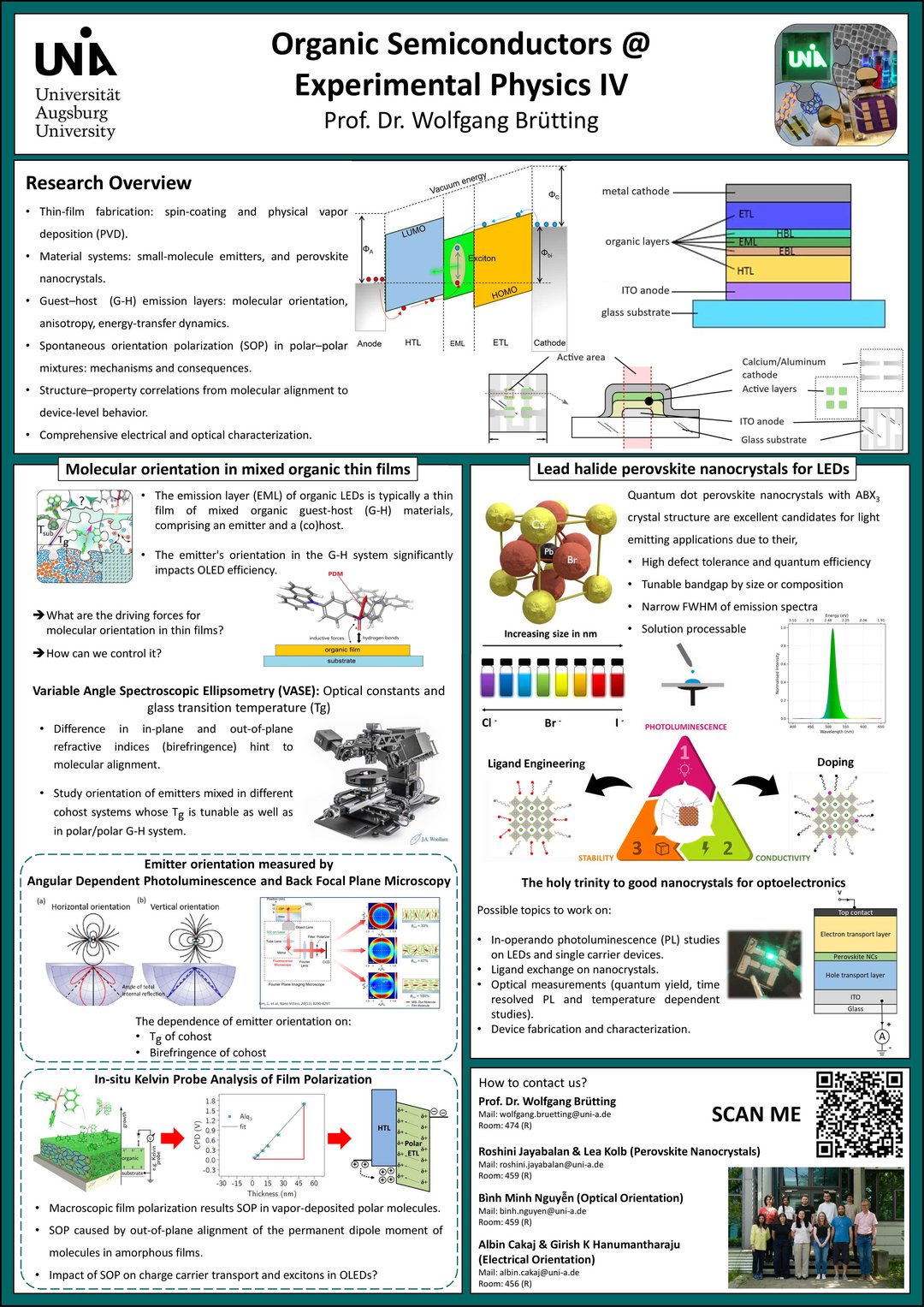
Molecular orientation and SOP in organic thin films
? University of Augsburg

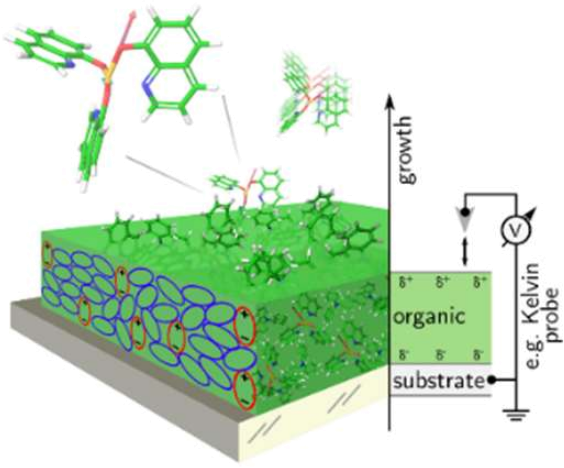
Controlling SOP in Organic Thin Films through Substrate Templating Effects
Introduction:?Due to their molecular nature, organic semiconductors are, unlike their inorganic counterparts, extended objects. This ultimately leads to a unique feature of organic semiconductors: molecular orientation in thin film. In other words: the orientation - alignment or "direction" - of each individual molecule in respect to the substrate largely influences light absorption and emission, in many ways. Additionally, in case of so-called polar moledules, which exhibit a permanent dipole moment on the molecule, the orientation also influences electrical parameters, such as charge transport and injection. Spontaneous Orientation Polarization (SOP) describes such an effect, where the permament dipole of the molecule is ordered in the finished thin film.
?
Goal: Examine how substrate layer, softness, and morphology affect polar-molecule orientatioon by fabricating controlled substrates and probing them with Kelvin probe. You'll be preparing (mostly single layer) thin films on various substrates by vacuum deposition and measure the surface potential using our Kelvin Probe setup.
?
? University of Augsburg

Exciton-Polaron Quenching in TADF OLEDs

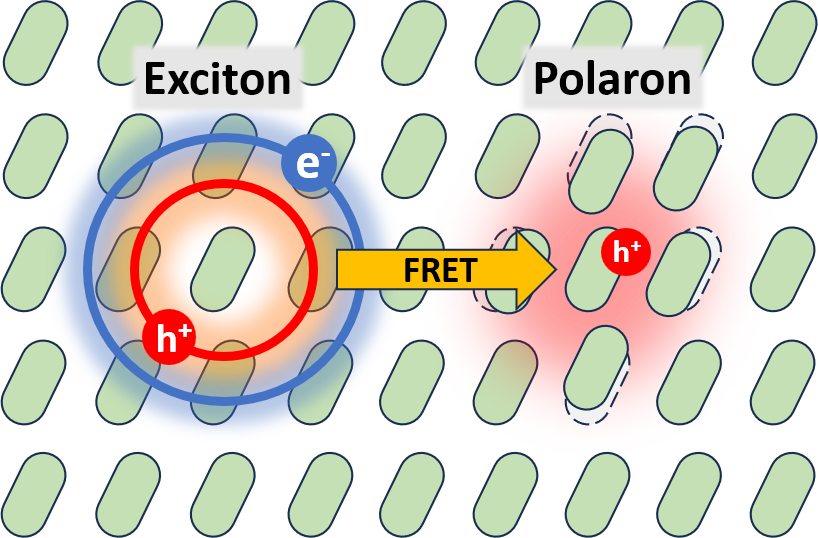
Introduction:?Exciton–polaron quenching is a non-radiative loss mechanism in organic light-emitting diodes (OLEDs), arising from interactions between excitons (bound electron–hole pairs) and polarons (mobile or trapped charge carriers) through F?rster resonance energy transfer (FRET). Here, we investigate exciton-polaron quenching in thermally activated delayed fluorescence (TADF) OLEDs due to Spontaneous orientation polarization (SOP)-induced charge accumulation at organic interfaces.
?
Goal: The goal is to study how electron and hole polarons interact with excitons and reduce device efficiency and stability. Multi-layered device architectures will be fabricated via vacuum vapor deposition with controlled SOP in the transport layers and characterized with respect to their SOP magnitude (using Kelvin probe measurements), electrical performance (using Current density-Voltage-Luminance, External quantum efficiency, and impedance measurements), and quenching dynamics (using bias-dependent and time-resolved photoluminescence/electroluminescence studies).

This work can be extended to a Master’s thesis by studying the emission layers with different guest-host systems, focusing on the optimization of host polarity and doping concentrations to minimize interfacial interactions between the emissive layer and SOP-active transport layers composed of polar organic molecules.
?
Contact: If you are interested, please contact? Girish K. Hanumantharaju
?
? University of Augsburg

Host Effects on TADF Emitter Orientation and Emission

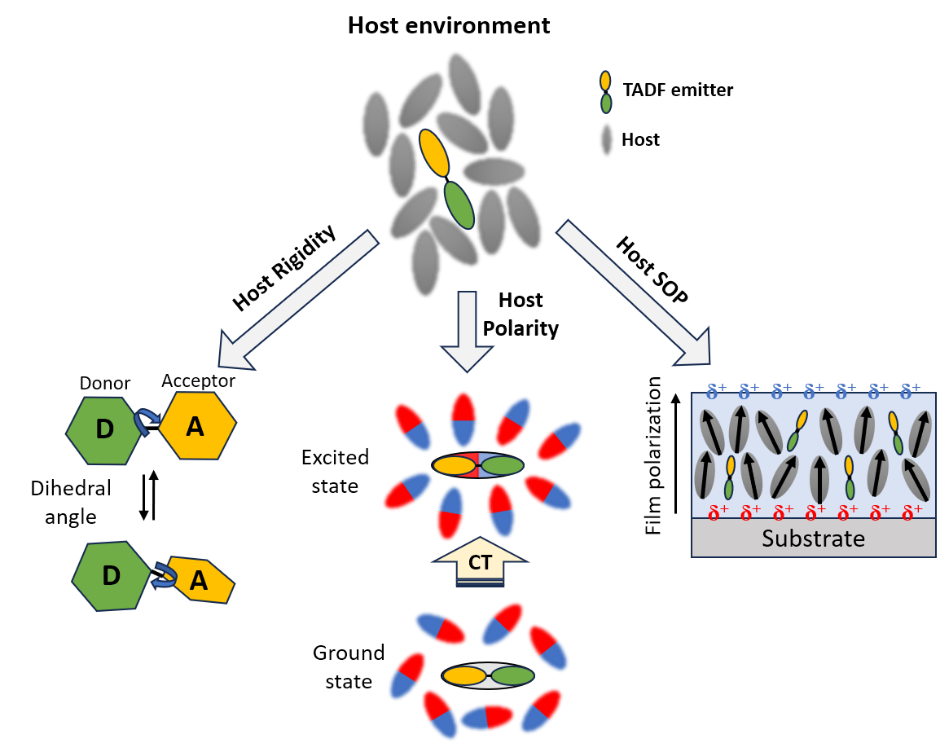
Introduction: The orientation and emission behavior of TADF emitters in doped amorphous host films are strongly influenced by host polarity, rigidity, and spontaneous orientation polarization (SOP). This work investigates how these host-dependent factors govern molecular\transition dipole moment orientation, optical energy levels, and emission characteristics. In particular, the role of the host dielectric environment and dipole interactions in modifying the emitter’s frontier orbitals and alignment is examined to understand their impact on optical performance.
?
Goal: TADF doped guest-host thin films will be fabricated via vacuum vapor deposition and characterized in terms of SOP magnitude (Kelvin probe), molecular orientation (angular-dependent photoluminescence), and refractive index (ellipsometry). Emission dynamics and local interactions will be further analyzed using steady-state and time-resolved photoluminescence to establish correlations between SOP and radiative efficiency.
For a Master’s thesis, this study can be extended to optimize guest-host systems by tuning dielectric properties and doping concentrations to enhance light outcoupling in high-efficiency OLEDs.
?
Contact: If you are interested, please contact? Girish K. Hanumantharaju
?

?

Lead halide perovskite nanocrystals for LEDs
? University of Augsburg

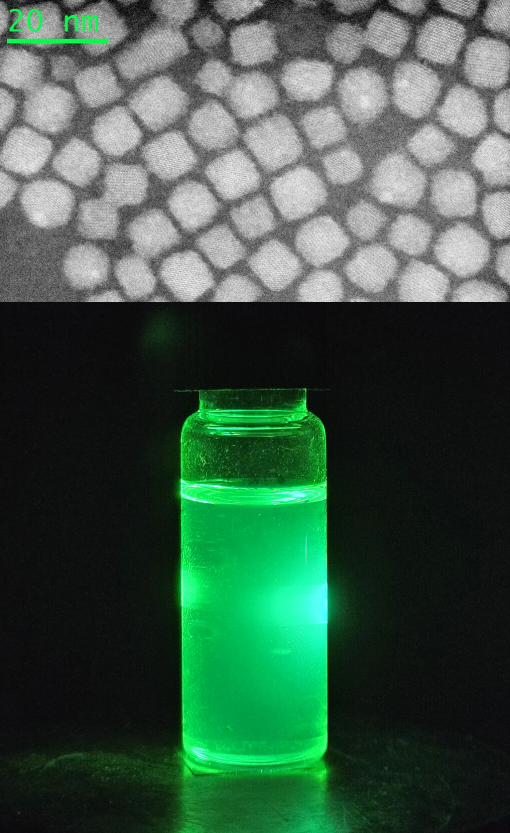
Synthesis of colloidal?CsPbBr? Nanocrystal Solutions and Optical Characterization of Spin-Coated Films

Goal: Different batches of CsPbBr? nanocrystals with controlled sizes and/or surface ligands will be synthesized by systematically tuning the reaction parameters. Thin films of the synthesized nanocrystals will be prepared via spin-coating and characterized with respect to their morphology (using atomic force microscopy), refractive index (using ellipsometry) and emission orientation (using angular dependent photoluminescence).?
For a Master’s thesis, this work can be extended to include the synthesis of CsPb(Cl:Br)?, FAPbBr? or MAPbBr? nanocrystals (FA = formamidinium, MA = methylammonium), and/or the investigation of interactions between nanocrystal layers and topping layers composed of organic molecules.

Note: Individuals with chemistry background are highly appreciated.

Contact: Interested? :-) Just contact? Lea Kolb - German or English is fine.
Search