

Waste Management at the University of Augsburg
A well-designed waste management system is a key component of sustainable practices at universities. It is based on the waste hierarchy—avoidance, reuse, recycling—and thus focuses on conserving resources and reducing environmental impact. Through targeted separation, recovery, and reduction of waste, the university helps to minimize its ecological footprint while raising awareness among students and staff about sustainable practices.
?
Waste separation on campus – need for action and goals:
Currently, the various waste fractions at the university are only separated to a limited extent. Although contracts have been concluded with the contracted waste disposal companies that provide for subsequent fractionation of mixed waste, no detailed information on the effectiveness of this post-treatment is available to date. Against this background, the university assumes that more consistent separate collection directly on campus – even taking into account possible misplaced items – can significantly increase resource efficiency. Accordingly, the university recognizes the need for improvement in waste separation and is actively working on its implementation. The goal is to establish separate collection of paper, cardboard, carton (PPK), recyclables (plastic, metal, composites), organic waste, and residual waste on the main campus. This requires the support of all employees and students. The waste management concept focuses on buildings where processes can be directly controlled, in particular the main campus (including MRM), the medical campus, and Eichleitnerstra?e, with Grottenau as a secondary location. ?[More on the current status of work here]
?
?
WASTE MANAGEMENT AT THE UNIVERSITY OF AUGSBURG:
Focus on the waste hierarchy and circular economy
?
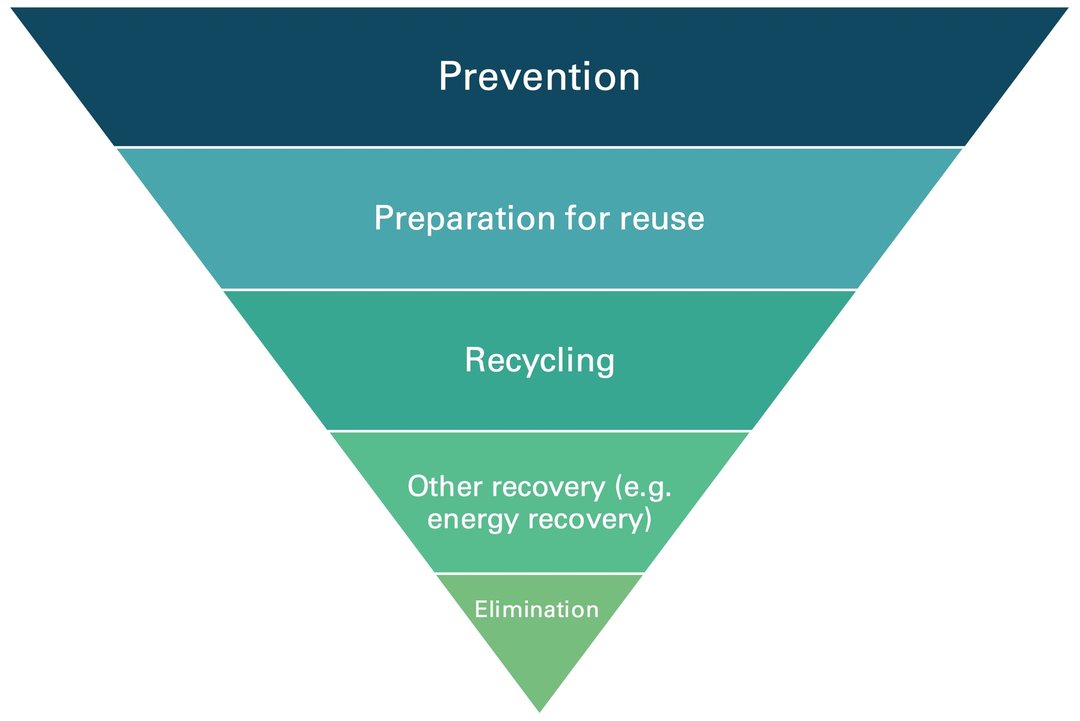
Waste management at the University of Augsburg is based on the waste hierarchy set out in the German Closed Substance Cycle Waste Management Act (KrWG), which specifies the order in which waste should be handled: avoidance, reuse, recycling, energy recovery, and only as a last resort, disposal. The aim is to reduce environmental impact and use resources efficiently.
?
The top priority is to avoid waste, for example by using products for longer or reusing them. If disposal is unavoidable, the possibility of treatment or recycling is examined. Only if this is not possible is energy recovery or final disposal used.
In this way, the university ensures that waste management is carried out systematically, in a resource-saving and sustainable manner – with the support of all students and employees.
Initial situation:
On the main campus, waste paper is collected in cardboard boxes and placed outside office doors, where it is picked up by the janitor. Other types of waste are collected and disposed of by the cleaning staff. Paper and residual waste are mainly disposed of in compactors located in buildings S, Mensa M, MRM (W), and D (freely accessible). A publicly accessible container for glass is available in the courtyard of the cafeteria. Food waste is collected separately in the cafeteria using a wet waste separator in the basement, as well as in the medical teaching buildings (LGB) and the old cafeteria. Plastic is not currently collected separately. At the medical campus, paper and residual waste are separated. At other locations, such as Eichleitnerstra?e, organic waste is also collected separately.?
?
Current challenges:
A working group consisting of the Green Office and employees from departments IV and V is currently addressing the following challenges::
?
- Contracts with cleaning and waste disposal companies:
The option for separate waste collection will be included in the current tenders. This option will be activated as soon as the university has created the necessary structures.
? - Storage of separated waste:
Additional containers are required for separate waste collection. The identification of possible locations and the number of containers required per waste fraction has not yet been finalized. Campus inspections were carried out in the fall to examine possible installation sites. A corresponding concept is currently being developed.
? - Equipment for cleaning staff:
It must be examined whether other cleaning vehicles need to be purchased to enable separate collection. In addition to the number of vehicles, suitable parking spaces would also need to be defined.
- Waste bins in offices and central areas:
Only paper waste should be disposed of in the offices. Organic waste, packaging waste, and residual waste are collected at central locations such as kitchenettes and in public areas.
?
A pilot project for waste separation is set to start in part of the campus in the first half of 2026. This will allow the concept to be tested initially, needs to be identified, and adjustments to be made, before it is gradually rolled out across the entire campus.
[Platzhalter]?
?
?
Waste sample from buildings T, R, and S
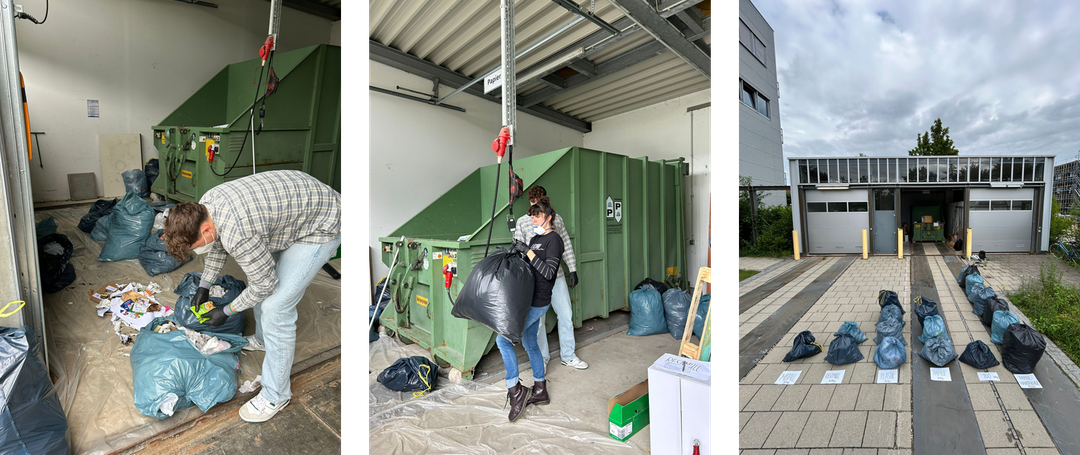
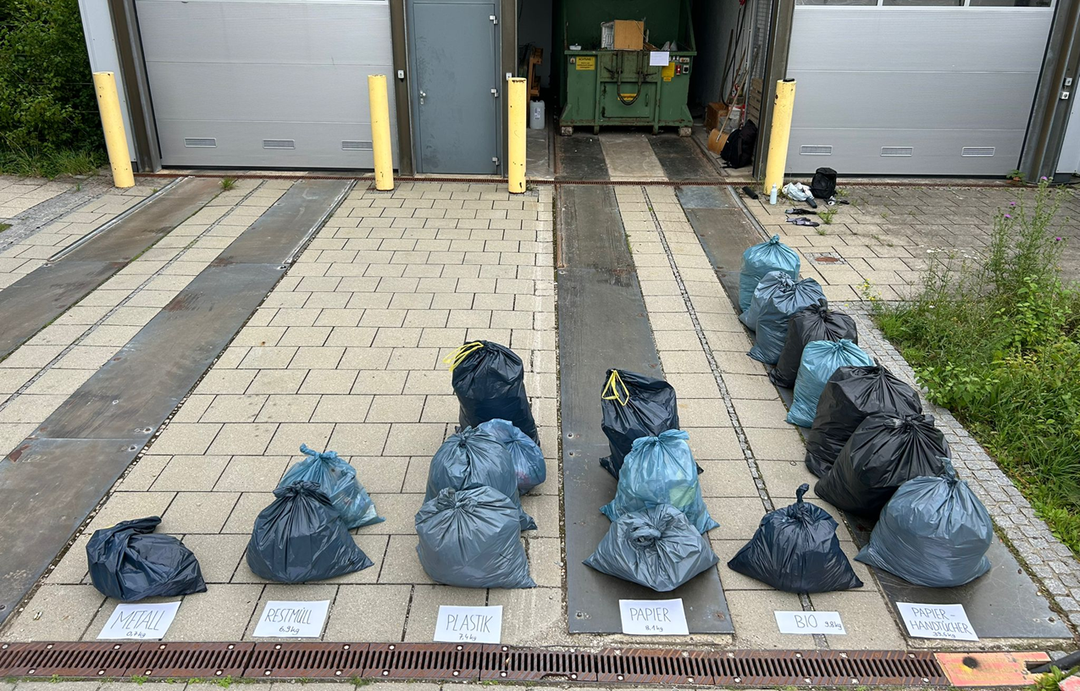
As part of a bachelor's thesis at ResourceLab and Green Office, a potential analysis for waste disposal at the university was developed. A central component of the thesis was a random sample analysis of the composition of residual waste at the collection point for buildings T, R, and S. In close coordination with departments V/4 (Mechanical Engineering) and V/6 (Safety Management and Environmental Protection), 72.5 kg of residual waste was sampled and divided into individual waste fractions. The sample provides a valuable assessment of the waste composition on campus, but as it focuses on the southern campus of the physics department, it cannot be fully applied to the university as a whole.
?
?
?
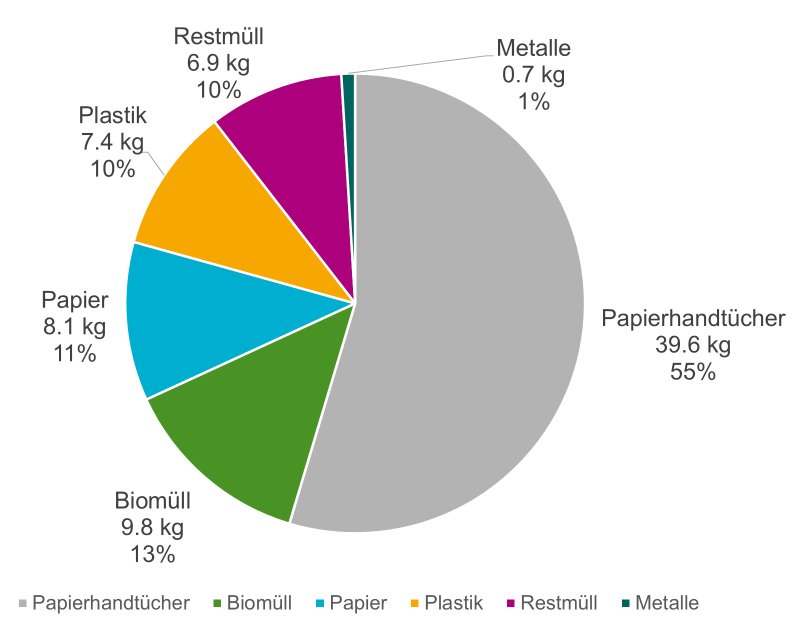
The evaluation shows that 65% of the waste examined can actually be classified as residual waste. The high proportion of paper towels is striking: they account for 55% of the total amount and must be disposed of as residual waste for hygienic reasons. The large quantity of unused towels is also noteworthy. This can probably be explained by incorrect removal from overfilled dispensers. The remaining content of the sample consisted of comparable proportions of paper, plastic, and organic waste. With consistent waste separation, these recyclable materials could largely be recycled.
?
?
Waste separation and reusable concepts on campus
Separate waste correctly – whether on campus or at home
This article shows how misfires can be avoided.
Campusbecher – reusable instead of disposable
Sustainability on campus begins with simple but effective measures such as the deposit system for reusable campus cups.
Contact
- Phone: +49 821 598 - 4087