

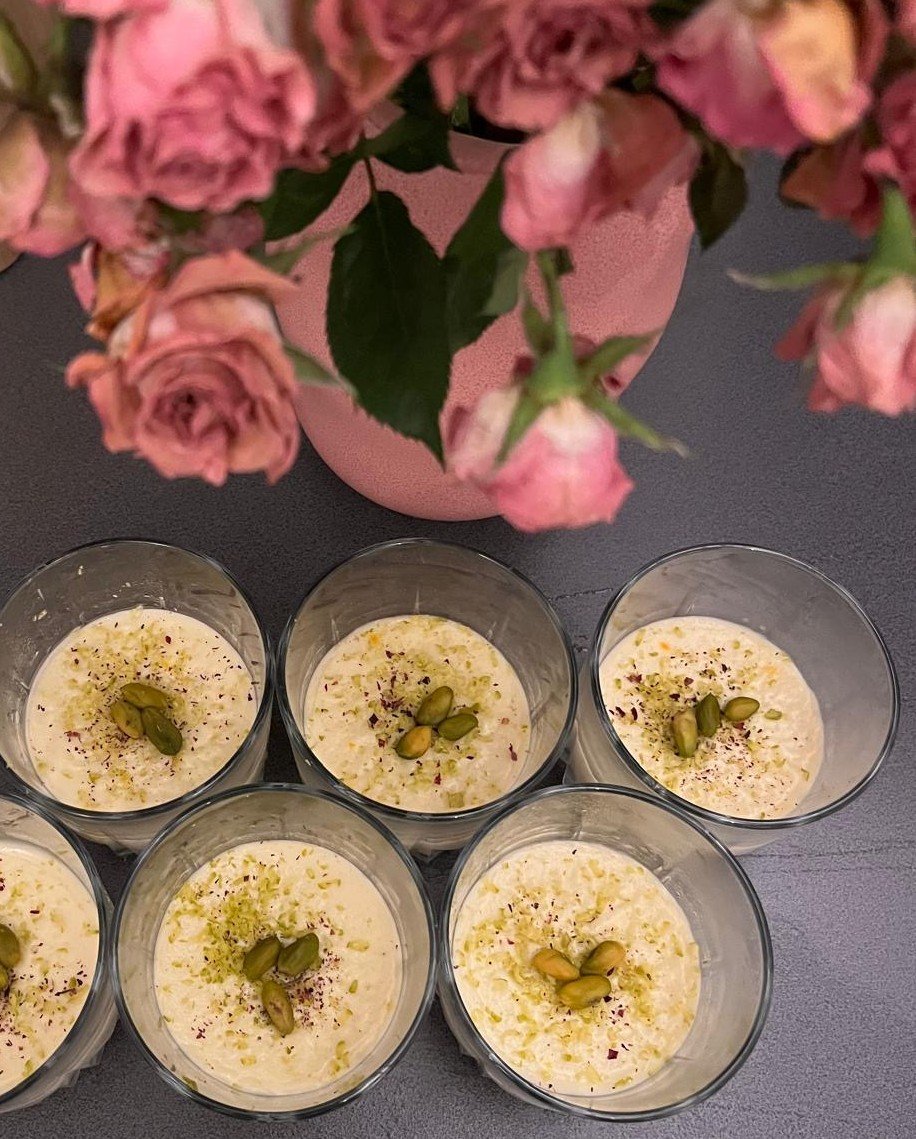
Fereni (Persian Rice Custard)
Ingredients
?
- Rice flour (60 g)?
→ You can find rice flour at “go asia” near the main train station in Augsburg!? - Cold water (80 ml)
- Whole fat milk (830 ml)
- Granulated sugar (80 g)
- Rose water (1,5 tablespoon)
→?You can buy rose water in Munich. There are many Persian shops near the main train station, which are easy to reach with the “Deutschland-Ticket”!? - Chopped unsalted pistachios for garnish (1 tablespoon)
? Otherwise, all you need is a small pan or pot and a stove - the ideal recipe for any dorm room kitchen!
?
?
Recipe
?
- Heat 230 ml milk in a non-stick pan over medium heat and bring it to a gentle boil. Stir occasionally with a silicone whisk to prevent sticking or burning.
- Meanwhile, in a small bowl, whisk the rice flour with the cold water until smooth and lump-free.
- Reduce the heat to medium-low. Gradually add the rice flour mixture to the hot milk, whisking constantly until it thickens and small bubbles begin to appear on the surface (about 5 minutes). Continue whisking for another 2–3 minutes.
- Add 120 ml cold milk and whisk over medium-low heat until it thickens again and small bubbles form (about 7–10 minutes).
- Add another 120 ml milk and whisk until slightly thickened but not bubbling. Then add the sugar and rose water, whisking until the mixture thickens once more and bubbles start to appear.?
- Increase the heat to medium and add the remaining 360 ml cold milk, 120 ml at a time. After each addition, whisk until the mixture thickens and small bubbles form before adding the next portion (each stage takes about 7–10 minutes). Keep whisking to prevent sticking.?
- Once all the milk has thickened and the custard is bubbling, whisk gently but continuously and simmer for another 3–5 minutes. The mixture should have a thin custard consistency and will thicken further as it cools.?
- Pour the custard into serving bowls immediately. Top with chopped pistachios and refrigerate uncovered for 2–3 hours to set. Cover with plastic wrap after chilling and store in the refrigerator for up to 3 days.?
Meet the person behind the recipe
Meet Anita!?
The recipe for Fereni was given to us by Anita. For each recipe in our collection, we talk to an international student. Here's what Anita told us about Persian cuisine:?
?
Hello Anita! Tell us a little bit about yourself!
I am currently studying to become a teacher at the University of Augsburg. My mother is from Iran and my father is German. Since I was born and raised in Germany, I unfortunately don't have many connections to Iranian culture. The last time I was there was in 2011, and I don't remember it very well. My cultural knowledge mainly consists of the language and Persian cuisine. Food was the easiest way to literally absorb a little bit of the culture. That’s why it’s so important to me!?
?
Do you enjoy cooking Persian food yourself?
Yes, I love cooking Persian food! However, I mainly cook simple and quick dishes.
Why is that?
Persian cuisine requires a lot of time and love. In Iran, it is common to cook large amounts of food and invite your neighbours over. Persian cuisine is meant to be shared. From that perspective, the time investment is more worthwhile.
Did you learn cooking from your mother?
Yes, but also from my grandmother. When she visited us in the summer, she often cooked for us. I learned a lot from her. She even let me make the “Tahdig”—the crust at the bottom of the rice pot. That was always an honour for me, because a successful Tahdig shows that you are a good cook. I also learned the cultural aspect of sharing food from my grandmother. When she waved me into the house for dinner as a kid, she naturally invited all my friends I was playing with to join us. That's why all the children in the neighbourhood also knew her as “Oma Sissi.” The dish I would like to share here is one I know from my grandmother.
?
?
Some more inspiration
Anita's favourite Persian dishes:
To eat: Ghormeh Sabzi
Translated, “Ghormeh” means “stew” and “Sabzi” means “herbs” – and that's exactly what it is: a stew with lots of herbs, beef or lamb, dried limes, beans, and rice, which has to simmer for a very long time to ensure the meat is tender.
To cook: Djudjeh Kabab
Traditional Persian chicken kebab that is simple and delicious!
For dessert: Faloodeh
Rose water ice cream. Anita has never made this herself, but she always orders it for dessert at the restaurant.
To drink:
With meals, Anita loves to drink dough, a savoury yogurt drink with mint or rose petals. And of course: strong black tea is a must after a Persian meal!
Persian cuisine on social media:
@persianmamablog: Anita's go-to source for Persian recipes. The recipe for fereni is also from there.
@theiranianvegan: an interesting account that makes non-Persian recipes Persian—and vegan! Anita recommends trying out the Persian-style potato salad recipe!?
?
Anita's favourite restaurant:
Her favourite restaurant is “Shandiz” on Dachauer Stra?e in Munich. It's very close to the main train station and therefore easy to reach with the “Deutschlandticket”! There are also many other Persian restaurants in this area. According to Anita, however, Shandiz serves the most delicious Persian food she has ever eaten—apart from her grandmother's, of course.
→?If you're a student and don't have the money to eat out, the lunch menu might be something for you. From Monday to Friday, 11:30 a.m. to 2:30 p.m., the prices are more affordable!
Merci, Anita!