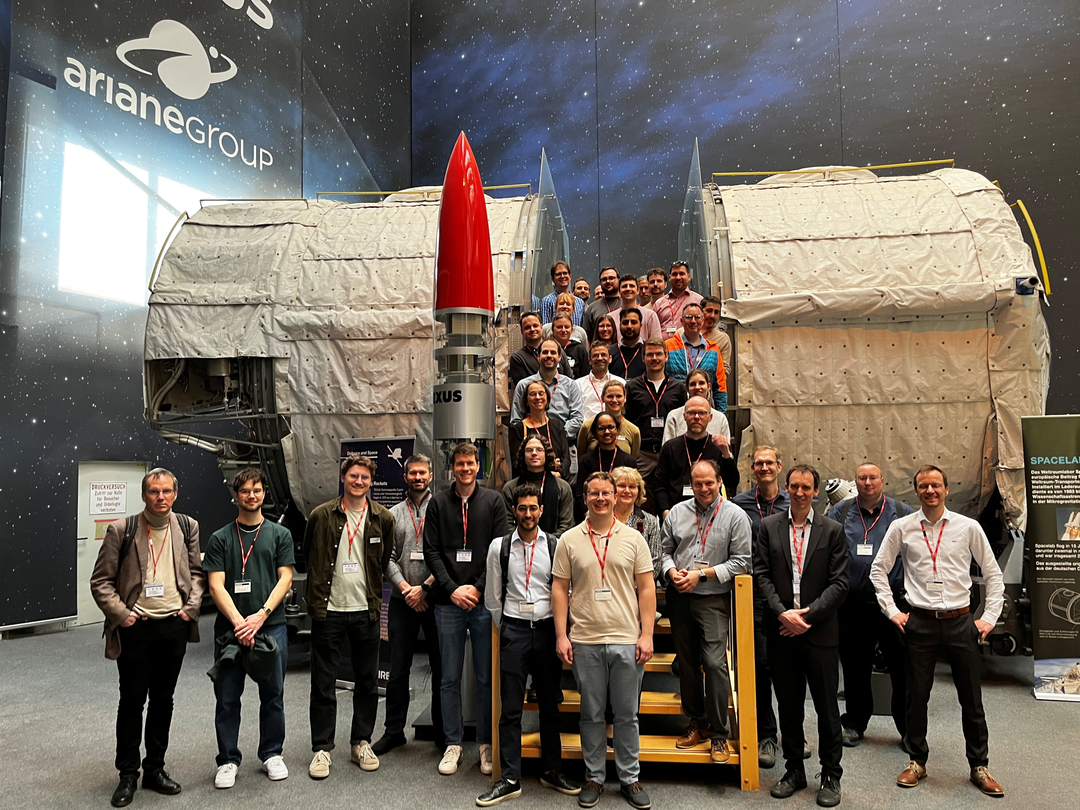

Resource Lab to be represented at the CU Ceramic Composites March Meetings 2026 in Bremen
Florian Halter and Lars Wietschel represented the Resource Lab at the “CU Ceramic Composites March Meetings 2026” in Bremen. In the working group on “Reinforcement of Ceramic Materials”, Florian Halter presented the findings of the recently published paper “Quantifying environmental impacts of circular economy approaches through life cycle assessments: A case study in materials science on ceramic matrix composites”, which was produced as part of his doctoral thesis. The publication represents one of the central components of the “CU EcoCeramic” project, funded by the Federal Ministry for Economic Affairs and Energy (BMWK), in which the Resource Lab participated from April 2022 to December 2024. The aim of the project was to characterise the current environmental and economic footprint of ceramic matrix composites. In addition, the potential for improving the environmental performance through process optimisation and circular economy approaches was investigated. The results highlight the currently high environmental impact of CMC production: greenhouse gas emissions of 35–50 kg CO? eq. per kg of CMC in the LSI process.? The project has resulted in several scientific publications that reflect the current state of research on Sustainable Ceramic Matrix Composites (SCMC). The literature review “Techno-Sustainable Analysis of Circular Economy Indicators for Corporate Supply Chains” analyses indicators for assessing the circular economy (CE) at product and company level and develops a set of indicators for CMCs. The publication “Environmental Impacts of Ceramic Matrix Composites Production via Liquid Silicon Infiltration” compares CMCs with conventional steel aircraft brakes using the life-cycle assessment method and demonstrates ecological advantages due to lower weight and longer service life, despite higher production impacts. The manuscript “Environmental Impacts of Ceramic Matrix Composites Production via Liquid Silicon Infiltration” examines various process variants of generic state-of-the-art (SotA) CMC components, identifies potential for optimisation, and is currently undergoing the review process. The publications can be viewed on the Resource Lab publications page.?