

New “Roadmap” highlights surface acoustic wave technologies
Publication provides insights into trends and developments in the coming decade
With the involvement of the University of Augsburg, international researchers have presented a new roadmap for surface acoustic waves. Co-coordinated by Prof. Christoph Westerhausen, the publication outlines how this technology will evolve over the next ten years, spanning applications from signal processing to quantum technologies and the life sciences. The roadmap is regarded as an important guide for research and practical applications. The application of surface acoustic waves is widespread. The spectrum ranges from modern communication technologies, for example wireless data transmission with smartphones, to the life sciences, where tiny amounts of matter are examined. The importance of acoustic surface wave technologies will continue to grow, according to the forecast of more than fifty leading researchers from around the world who contributed to the current publication “2026 Guided Acoustic Wave Roadmap“. The publication provides an overview of the advances and developments in the dynamically growing research field of acoustic waves in solids. The roadmap, published in the “Journal of Physics D: Applied Physics”, was coordinated by Prof Hubert J. Krenner (University of Münster), Dr. Paulo V. Santos (Paul Drude Institute for Solid State Electronics (PDI)) and Prof. Dr. Christoph Westerhausen (University of Augsburg). Surface acoustic waves (SAWs) are mechanical vibrations that propagate along the surface of a material. Since they can strongly interact with electronic, optical and magnetic excitations, SAWs provide a powerful way to manipulate physical processes in solid-state systems. Originally, they were mainly used in radio-frequency filters and sensing technologies. Today, SAW-based approaches are increasingly being applied in quantum technologies, optomechanics, in hybrid photonic-phononic systems and in advanced signal processing. For Paulo V. Santos, the roadmap reflects several decades of scientific development in a research field that he helped to shape. “Surface acoustic waves have evolved from a tool for classical signal processing into a versatile platform for controlling elementary excitations in advanced materials,” he notes. Hubert Krenner adds: “We witness a clear focus on the use of SAWs to couple modern nano- and quantum systems on innovative material platforms. An example is hybrid quantum chips that interconnect light and sound waves.” The roadmap assembles contributions from leading researchers, each highlighting progress and challenges in their area of expertise. Together, they provide an overview of how SAW-based concepts are evolving across materials science, condensed-matter physics and device engineering. By bringing together perspectives from the international research community, the Surface Acoustic Waves Roadmap 2026 provides a comprehensive orientation point for academics as well as engineers working on acoustic waves in solids or exploring new ways to use sound to control matter on the nanoscale. Christoph Westerhausen emphasizes: ?We cover a very broad spectrum of nanoscience from modern quantum technologies to bioscience. The same acoustic wave serves as a carrier of quantum information and controls living cells in a thumbnail-sized laboratory on a chip “ The new roadmap directly builds on the “Surface Acoustic Waves Roadmap” from 2019. This earlier publication painted a comprehensive picture of a rapidly developing research field and formulated central perspectives for future work. In the past few years, many of these former visions have developed into active research directions, while new scientific and technological possibilities have emerged at the same time. The Roadmap 2026 continues this development. ? Title: The 2026 guided acoustic waves roadmap Authors: H. J. Krenner, P. V. Santos, C. Westerhausen , G. Andersson, A. N. Cleland, H. Sellier, S. Takada, C. B?uerle, D. Wigger, T. Kuhn, P. Machnikowski, M. Wei?, G. Moody, A. Hernández-Mínguez, S. Lazi?, A. S. Kuznetsov, M. Kü?, M. Albrecht, M. Weiler, J. Puebla, Y. Hwang, Y. Otani, K. C. Balram, I-T. Chen, K. Lai, M. Li, G. R. Nash, E. D. S. Nysten, P. Bhattacharjee, H. Mishra, P. K. Iyer, H. B. Nemade, A. Khelif, S. Benchabane, G. Feng, Y. Jin, A. Bartasyte, S. Margueron, M. Marangolo, L. Thevenard, P. Rovillain, C. Gourdon, S. Hage-Ali, O. Elmazria, H. Schmidt, L. Y. Yeo, L. A. Ambattu, J. S. Jeon, D. Kwak, J. Rufo, S. Yang, T. Jun Huang Source: J. Phys. D: Appl. Phys. 59, 093001 (2026)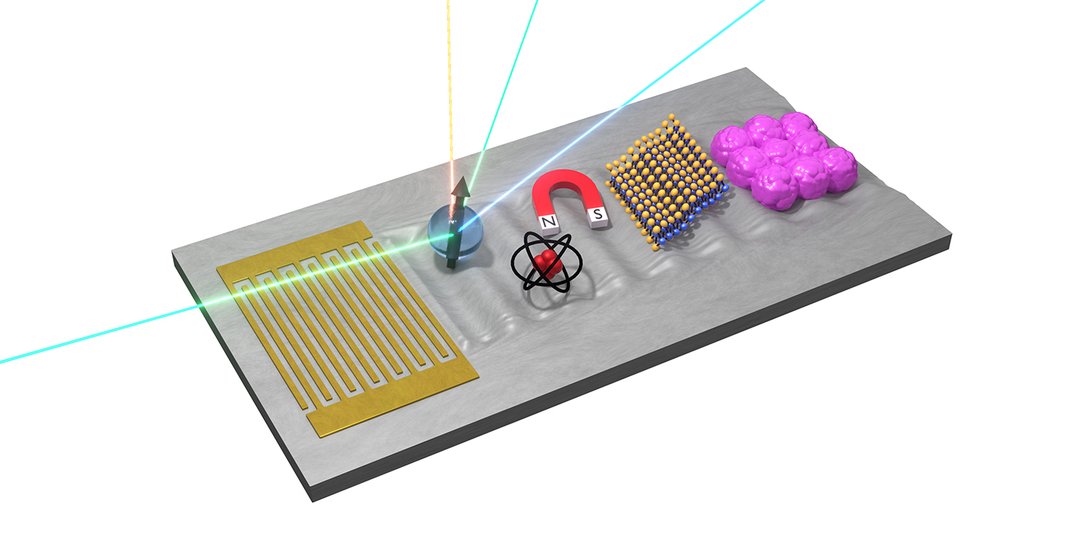
Roadmap as comprehensive guide
Original publication:
Scientific Contact
Media Contact