

One atom makes all the difference: Heat transport through molecules controlled in a targeted manner for the first time
Nature publication by Augsburg physicists
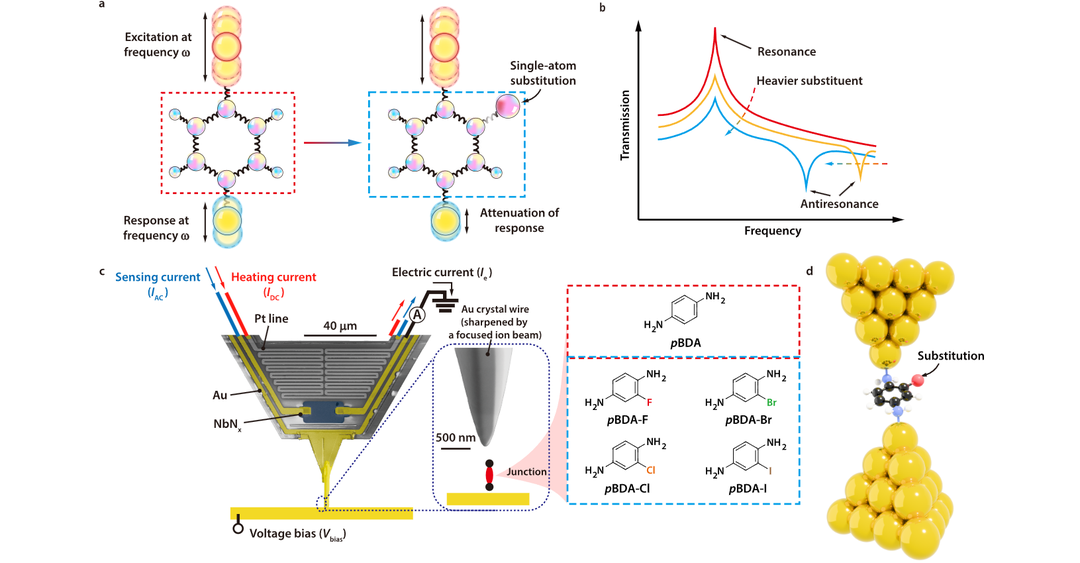
In close collaboration with researchers from the University of Michigan (USA), physicists in Augsburg have succeeded for the first time in proving experimentally and theoretically that heat transport through molecules can change by up to a factor of two through the exchange of a single atom. The results open new avenues for the targeted control of heat flows at the atomic level and are significant for the further development of nanoelectronic components, thermoelectric materials and metal-organic framework compounds. The study was published in the highly renowned journal Nature Materials. ? Control of heat transport in nanostructures is of central importance for numerous modern technologies – from high-performance computer chips that need to be cooled to energy converters – and is a highly active area of research. While great progress has been made in recent years in understanding how heat transport can be influenced by nanostructuring, it was previously unclear whether the replacement of a single atom in a molecule could measurably alter phonon transport – i.e. heat transport through lattice vibrations. In a new study, an international team of researchers from Augsburg and Ann Arbor (Michigan, USA) has now shown that this is indeed possible. The study focuses on so-called single-molecule contacts, in which a single molecule connects two gold electrodes – the smallest conceivable thermal components. The starting point for the study is benzene diamine (BDA). The molecule consists of a benzene ring – one of the basic building blocks of organic chemistry – and two nitrogen groups, the amino groups, which enable targeted contacting via gold electrodes. A single hydrogen atom on the benzene ring was replaced by increasingly heavier halogen atoms: fluorine, chlorine, bromine and iodine. While the electrical conductance of these molecular contacts hardly changed as a result of the substitution, the measurements show a clear trend in heat transport: the heavier the atom used, the lower the thermal conductance. The difference between the unsubstituted molecule and the iodine-substituted variant is almost a factor of two. The study builds on many years of collaboration between Prof. Fabian Pauly's theory group at the University of Augsburg and the experimental working groups of Prof. Edgar Meyhofer and Prof. Pramod Reddy at the University of Michigan. Together, the teams have achieved breakthroughs in the field of thermal transport at the atomic and molecular level in recent years. The present work builds on these successes and expands the understanding of the control of heat transport through single atom substitution. The findings are not only relevant for the basic understanding of heat transport at the atomic level. They also provide important insights into how heat transport in metal-organic frameworks (MOFs), covalent organic frameworks (COFs) and molecular thermoelectric materials can be specifically optimized. In all these material classes, molecules form the connecting elements, and the targeted substitution of individual atoms could serve as a new design principle for tailoring thermal properties. The work at the University of Augsburg was funded by the German Research Foundation (DFG) as part of the Collaborative Research Centre (SFB) 1585 (project number 492723217, subproject C02). The calculations were performed on the LiCCA high-performance computer cluster at the University of Augsburg (DFG project number 499211671). The experimental work in Michigan was funded by the US Department of Energy (Basic Energy Sciences, Award Number DESC0004871), the Office of Naval Research (Award Number N00014-24-1-2132), the National Science Foundation (Award Number CBET 2232201) and the Army Research Office (Award Number W911NF2310260). Yuxuan Luan*, Matthias Blaschke*, Yuji Isshiki, Jian Guan, Fabian Pauly, Edgar Meyhofer & Pramod Reddy, Tuning Phonon Transmission via Single-Atom Substituents. Nature Materials [2026]. (*Shared first authorship):?
https://www.nature.com/articles/s41563-026-02568-9 ?
Systematic variation through halogen substitution
"The fact that individual atoms have such a strong influence on heat transport, while charge transport remains virtually unchanged, opens up the fascinating possibility of controlling thermal and electric current independently of each other in molecular materials," says Prof. Dr. Fabian Pauly, whose theory group at the Institute of Physics at the University of Augsburg has elucidated the fundamentals of these observations.Novel theory explains the mechanisms
For the measurements, the team in Michigan developed a novel calorimetric scanning probe sensor which, thanks to a niobium nitride thermometer, achieves a resolution at cryogenic temperatures (approx. -180 °C) that is an order of magnitude higher than previous systems. By using particularly sharp tips of the scanning probe and the cold temperatures, it was possible for the first time to achieve a negligible thermal background – an important prerequisite for measuring the extraordinarily small heat flows through individual molecules.
Matthias Blaschke, a doctoral student in Prof. Fabian Pauly's research group and one of the two lead authors of the study, travelled to the University of Michigan as part of the project to work closely with the American project partners. "The personal contact on site enabled me to compare the calculations directly with the measurement data and thus elucidate the physical mechanisms behind the observed attenuation of heat transport," says Matthias Blaschke. Specifically, the theoretical modeling in Augsburg shows that substitution by heavier atoms breaks the high symmetry of the molecule, thereby suppressing constructive interference between the vibrational modes. In the case of particularly heavy substituents such as bromine and iodine, new antiresonances additionally occur in the transmission function, which further reduce the heat flow.
"This long-standing partnership between Augsburg and Michigan, characterized by intensive scientific exchange, is the basis for the breakthroughs we have achieved together in recent years," emphasizes Prof. Fabian Pauly.Significance for future applications
Funding
Publication
Media contact